MCP server
The Model Context Protocol (MCP) server gives any compatible AI client a standard way to use Veck — search deal flow and investors, read Radar updates, and add or manage Radar tracking (LinkedIn / X) in plain language.
Connect natively in Claude, ChatGPT, Cursor, and other MCP clients. The server is hosted by Veck and proxies each call to the Client API with your credentials. It does not store your data.
For help getting started after setup, see common use cases.
⏺veck · search_signals(stage: pre-seed, min_investors: 3, since: 7d)
⎿ 11 signals · 4 already in Attio · 7 new
Seven new founders. Three left senior engineering roles in the last 60 days, and two share the same four investor followers, which suggests a co-founder pair.
Want me to add the top three to your pipeline?
Setup
General
Our MCP server uses Streamable HTTP at the following address. The interactive setup flow uses OAuth 2.1 with dynamic client registration — you sign in with your Veck account; no token paste required.
https://mcp.theveck.com/
One-click OAuth connect is available for Claude (Anthropic), ChatGPT, and Cursor. Other MCP clients are not registered by default — email us if you need yours added, or authenticate with a token (see FAQ).
After connecting, start the session with: Call get_my_access. That returns your plan, rate limit, and enabled areas. Call it once per chat.
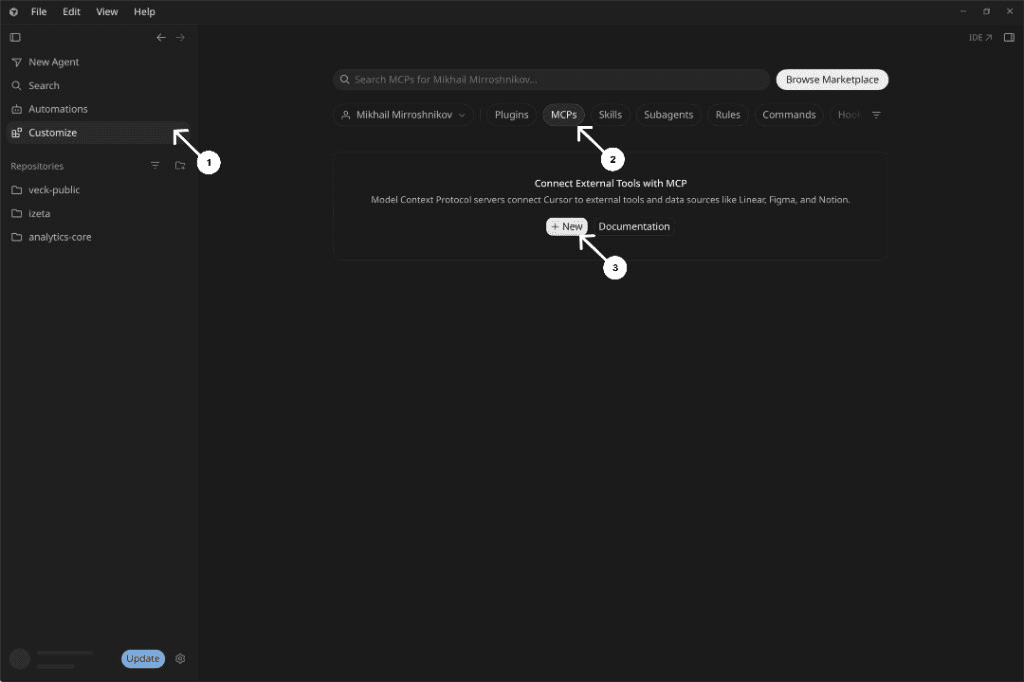
In Cursor, open Customize → MCPs, then click + New:
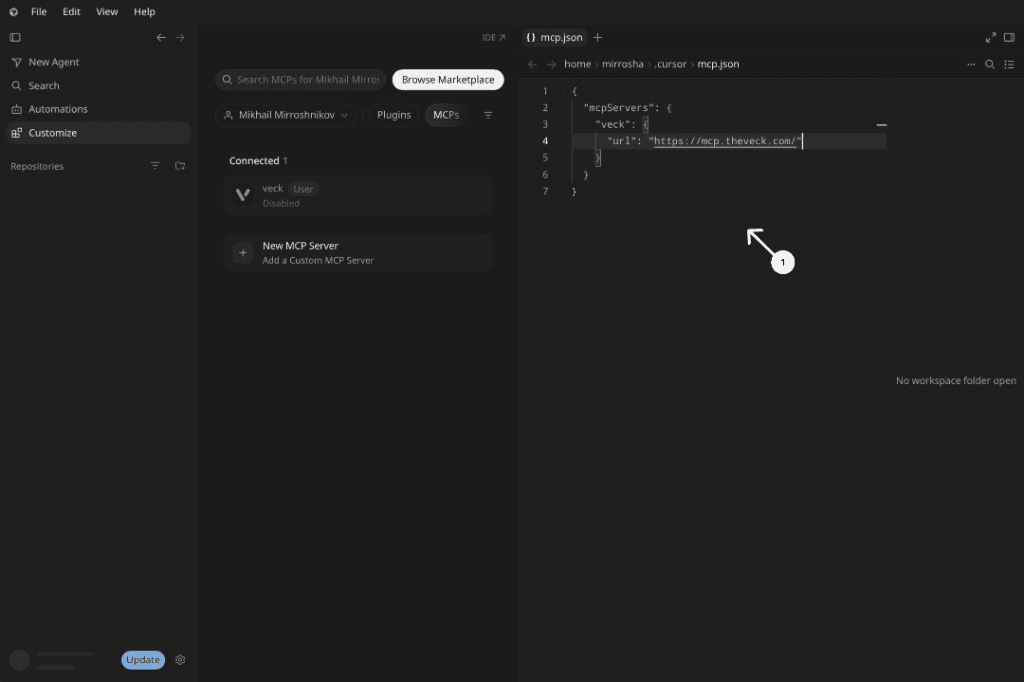
Add the Veck server URL in ~/.cursor/mcp.json (Cursor opens this file when you create a custom server):
{
  "mcpServers": {
    "veck": {
      "url": "https://mcp.theveck.com/"
    }
  }
}
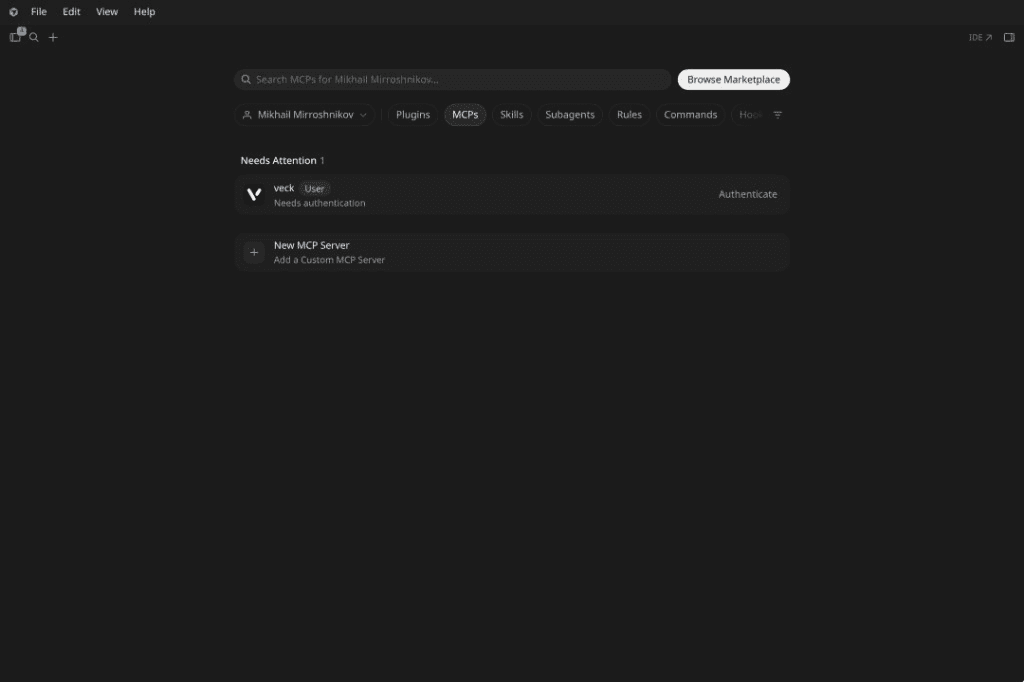
Back on the MCPs list, Veck shows under Needs Attention. Click Authenticate:
In the Configure dialog, click Authenticate:
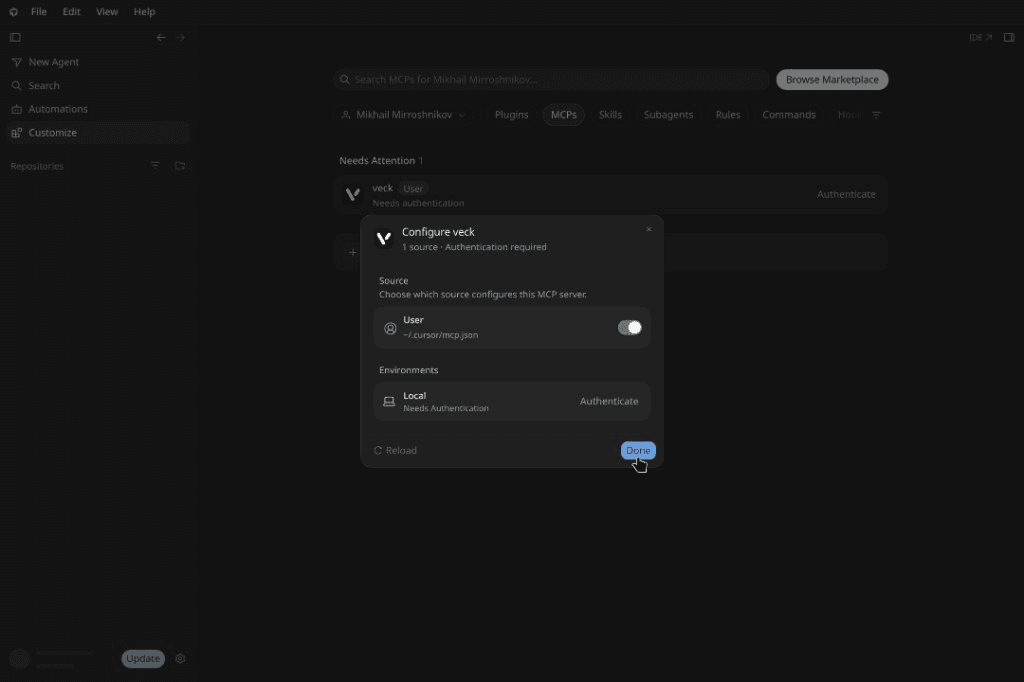
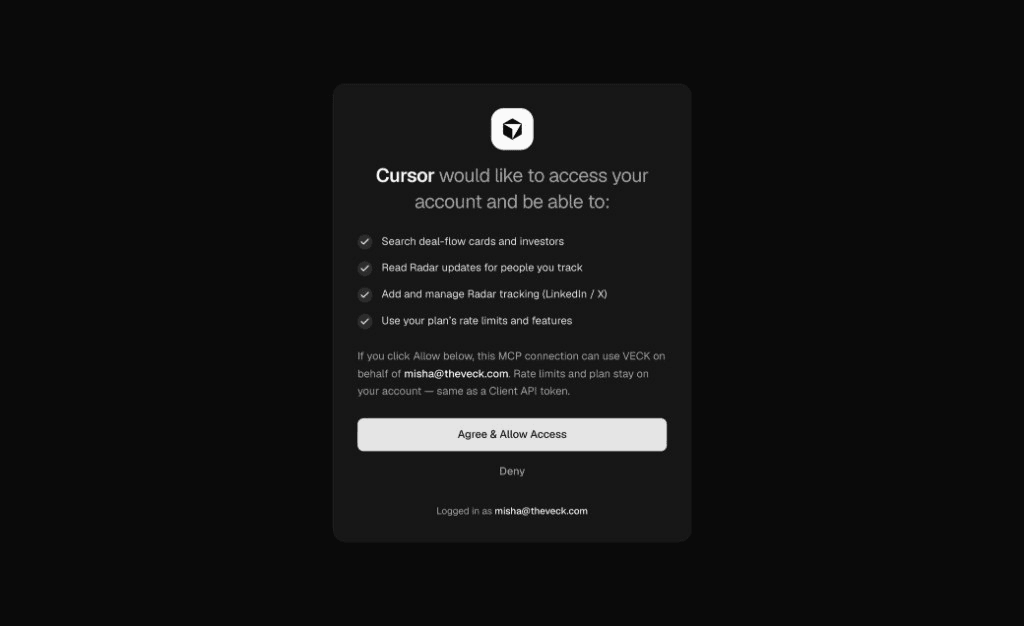
Sign in with your Veck account in the browser, then click Agree & Allow Access. Back in Cursor, click Done:
From Claude settings → Connectors, add a custom connector:
- URL:
https://mcp.theveck.com/ - Authentication: OAuth (always required)
- Client ID: leave empty — register automatically
- Sign in with your Veck email and password, then Allow
Add a connector / app pointing at https://mcp.theveck.com/. Use OAuth with automatic registration, then sign in on the Veck authorize page.
Add a remote MCP server with URL https://mcp.theveck.com/ and complete the OAuth sign-in when prompted.
Need Windsurf, Zed, VS Code, a custom agent, or another MCP host? Interactive OAuth only works for clients we have allowlisted. Write to misha@theveck.com and we can add your client, or connect with a Client API / OAuth access token in the Authorization header (see FAQ). Endpoint stays the same: https://mcp.theveck.com/.
Common use cases
The MCP server lets you work with Veck data from any compatible AI client. Copy an example prompt into your client to explore what is possible.
Session start
Confirm what your account can access before you search or touch Radar.
Example prompt
Call get_my_access and tell me what I can use — plan, remaining rate limit, and enabled areas.
LinkedIn-sourced discovery
Find companies whose first signal came from LinkedIn, then open detail only for the shortlist.
Example prompt
Find new AI companies that first appeared via LinkedIn. Use compact search, then open full cards for the top three.
Morning Radar brief
Summarize career moves and founder signals for people you already track.
Example prompt
Morning Radar brief — what changed for people I track? Focus on each update's description.
Track a founder
Look up a LinkedIn or X profile, then add them to Radar if they are not already watched.
Example prompt
Add https://linkedin.com/in/jane-founder to Radar. Look them up first, then create the application if needed.
Investor portfolio signals
Resolve a fund or investor, then pull recent company signals tied to them.
Example prompt
Find a16z signals from the last week. Resolve the participant first, then search related cards.
Semantic discovery
Use natural-language search inside hard filters like stage and location.
Example prompt
Find pre-seed companies in the Bay Area with semantic search. Keep the first pass compact (limit 10–15).
FAQ
Interactive OAuth connect is available for Claude (Anthropic), ChatGPT, and Cursor. Other MCP hosts are not allowlisted by default. Email misha@theveck.com if you need another client added, or use a token in the Authorization header (see below).
Yes. For clients without interactive OAuth, or for headless agents, pass a token in the Authorization header instead of the browser sign-in flow:
{
  "mcpServers": {
    "veck": {
      "url": "https://mcp.theveck.com/",
      "headers": {
        "Authorization": "Bearer YOUR_TOKEN"
      }
    }
  }
}
Authorization: Token YOUR_TOKEN also works. Prefer interactive OAuth for day-to-day use in Claude, ChatGPT, and Cursor. Limits stay on your Veck account or group either way.
Check that the MCP server is enabled, the URL is https://mcp.theveck.com/, and you finished Connect / OAuth. Restart the client after editing config, then ask it to call get_my_access.
The OAuth session expired or auth never completed. Disconnect and reconnect the server from your client’s MCP settings, then sign in again.
Those tools appear only with an extra permission. Without it, use LinkedIn-sourced cards: search_cards(source_types=linkedin) → get_card (includes linkedin_profile).
Prefer compact search (view="compact", limit 10–15) and open full cards only for shortlisted companies. On 429, stop retrying — free plans use lifetime quota; paid resets at UTC midnight. If semantic search is temporarily unavailable, the agent falls back to classic search.
Disconnect and reconnect the server from your client’s MCP settings. This is a routine client-side reset and does not affect your Veck data.
Prefer raw HTTP? See the REST API documentation. Sending to a CRM? See connectors.